Why is the blind test so fascinating ?
The psychological influence of the label is immense : a grand maison seems “ better ” than a winemaker, until the blind test reshuffles the cards. By neutralizing marketing, we reveal the sensory markers of the wine.
Champagne, Crémant, Prosecco… really that different ?
Blindly, confusion is common. Some top-quality crémants or well-made Proseccos can trap the palate. But champagne.fr/fr/champagnes”>a well-crafted Champagne leaves recurring clues : fine bubbles, mineral tension, autolysis (brioche notes), length.
Pitfalls of the palate
- Temperature : too cold = aromas cut off; too warm = alcohol/foam.
- Glass : the flute elongates the bubbles but restrains the nose; the tulip glass reveals the aromas.
- Dosage : a high sugar smooths out differences (Brut Nature/Extra-Brut read the terroir better).
Experience : organize your own blind test
- Select 3–4 bottles (Champagne, Crémant, Prosecco).
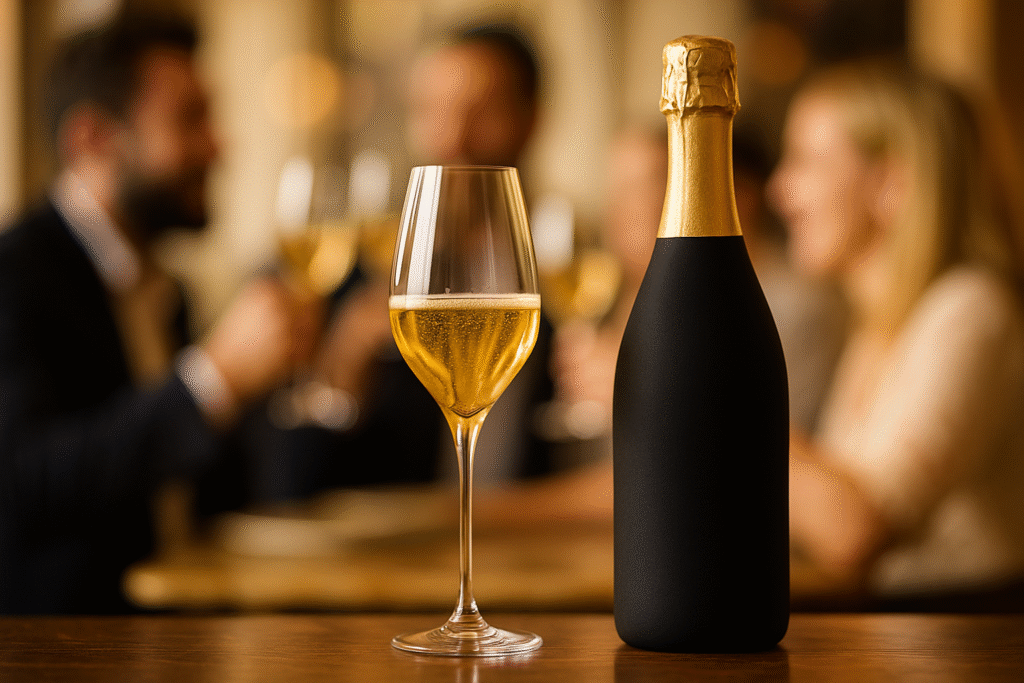
- Mask the labels (foil/black socks), serve at 9 °C in identical glasses.
- Note color, nose, palate, finish. Guess the origin, then reveal.
- Fun variant: the one who is wrong offers the next bottle 🍾
Surprising results (even pros get fooled)
In competitions, seasoned tasters sometimes confuse a very good crémant with a reputed Champagne. Proof that the blind test reshuffles perceptions… but does not prevent reading the right clues.
So, can we really recognize a Champagne blindfolded ?
Yes — if you know where to look. Champagne carries a signature born from the combination chalky terroir + noble grape varieties + traditional method. With some training, you spot its fine bubbles, its mineral tension, autolysis aromas (autolysis) (brioche, bread crumb, hazelnut) and its length.
How to guess where it comes from : the practical grid
1) Visual clues
- Color : Blanc de Blancs (chardonnay) very pale, green reflections ; Blanc de Noirs (pinot noir/meunier) more golden.
- Effervescence : regular bead, very fine and persistent bubbles = careful lees aging, frequent marker in Champagne.
2) Nose & palate: Champagne markers
- Autolysis (on lees): brioche, bread crumb, biscuit, hazelnut.
- Chalky structure : saline/mineral sensation in mid/end palate.
- Texture : creamy foam but tense, long and precise finish.
3) Sensory landmarks by major zones
- Montagne de Reims (pinot noir): red fruits (cherry, redcurrant), spicy hint; structured palate, noble bitterness.
- Vallée de la Marne (meunier): apple/pear, mirabelle; round, caressing palate.
- Côte des Blancs (chardonnay): citrus, white flowers, chalk ; tense, saline, very straight palate.
- Côte de Sézanne (ripe chardonnay): yellow fruits, light honey; acidity softer than Côte des Blancs.
- Côte des Bar (pinot noir on marl): ripe red/black fruits, spicy touch; ample palate, less sharp chalky finish.
4) Technical clues that guide
- Dosage : Brut Nature/Extra-Brut better reveal chalk/tension.
- Malolactic fermentation : without MLF = citric/bright structure; with MLF = buttery/lacteal touch.
- Wood (foudre/barrel): vanilla, fine toast, soft spices.
- Lees aging : the longer it is, the more autolysis and fine bubbles assert themselves.
5) 60-second checklist (blind)
- Observe fineness of bubbles and persistence of the bead.
- On the nose, look for brioche/hazelnut + citrus/white flowers + chalk.
- On the palate, note saline tension + creamy texture + long finish.
- Cross-check: very tense/saline → track chardonnay/Côte des Blancs ; ample/red fruit → pinot noir/Montagne de Reims or Aube ; round/apple-pear → meunier/Vallée de la Marne.
6) Common pitfalls
- Too cold : cuts aromas → aim for 8–10 °C.
- Flute glass : restrains the nose → prefer tulip glass.
- High dosage : masks chalk and tension.
7) Training exercise at home
- Line up 4 masked bottles: Blanc de Blancs Côte des Blancs, Blanc de Noirs Montagne de Reims, Meunier Vallée de la Marne, Pinot noir Côte des Bar.
- Serve at 9 °C in identical tulip glasses. Note color, nose, palate, finish.
- Unveil and match profile ↔ zone. Repeat with other houses.
- Bollinger Spécial Cuvée Brut (PN/Montagne de Reims, structure).
- Ruinart Blanc de Blancs (Chardonnay/Côte des Blancs, tension-chalk).
FAQ – The Champagne blind test
Can Champagne and Crémant be confused?
Yes, blindfolded, but Champagne often shows finer bubbles, autolysis (brioche) and chalky tension more marked.
Which glass to use to read the terroir?
A tulip glass (or small white wine glass) highlights the nose and texture better than a flute.
Does dosage distort perception?
Yes. The higher the dosage, the more it smooths differences. In Brut Nature/Extra-Brut, chalk and tension are better read.
Does price guarantee a taste difference?
Not always. Reputation and rarity play; a good grower Champagne can outperform a large house blindfolded.
Ideal temperature for a blind test?
8–10 °C. Too cold cuts aromas, too warm accentuates foam and alcohol.