
Introduction
The harvest in champagne.fr” target=”_blank”>Champagne 2025 begins under the sign of earliness and precise organization. The climatic dynamics of the year — mild spring, hot summer, rapid véraison — have accelerated the ripening of the berries. In this context, the sector opted for a harvest opening date set for August 20, in order to seize the best compromise between freshness, concentration, and aromatic expression. This article offers a comprehensive overview: weather context, schedule, yields, quality, markets, risks, and field feedback.
1. Climatic context of the 2025 campaign
The succession of hot and sunny episodes hastened véraison and quickly raised potential alcohol levels. Compared to a thirty-year average, the advance is measured in weeks, requiring increased vigilance on the sugar/acid balance. Intra-parcel heterogeneity remains a point of attention: daily observation of the berries and tasting of the musts guide the right picking time.
Flowering, véraison and ripening kinetics
Homogeneous flowering favored a compact véraison. The observed kinetics (daily degree gain, drop in titratable acidity) guide harvesting decisions according to grape varieties and exposures.
Recent comparison
At the scale of recent early vintages, 2025 fits into a trend of advancement in phenological stages, confirming the lasting impact of climate on the Champagne calendar.
2. Harvest opening date: schedule and scope
In Champagne, the « ban » is the official authorization to start harvesting. For 2025, it is set for August 20, a decision motivated by the advance in maturity and the targeted quality thresholds. The ban coordinates the sector, harmonizes practices, and secures the integrity of grapes intended for the production of Champagne base wines.
Role of bodies
The Comité Champagne and maturity monitoring networks aggregate field data (sampling, tastings, analyses) to propose an optimal window at the appellation level.
Practical consequences
Estates plan harvesters, trailer logistics, presses, and time slots. Houses organize the reception of musts and the allocation by crus and grape varieties.
3. Actual start by zones
Although the ban opens on August 20, actual departures vary according to the earliness of communes and parcel typology. Some zones start on D-day, others wait a few days to target a more achieved aromatic maturity.
Picking windows
Between August 20 and 27, most sectors begin operations, chaining rapid sorting to capture the best expression while avoiding localized overripeness.
Coordination of musts / presses
Press scheduling is adjusted to the increase in inputs and respects Champagne criteria (pressure, juice fractionation, separation of tails).
4. Regulation of yields & volumes
Marketable yield aims to reconcile availability, quality, and economic stability. The kg/ha objective is coordinated with stock management and sales trajectory to avoid imbalances and preserve the value of cuvées.
Stock/sales balance
Champagne relies on regulation mechanisms to smooth uncertainties and support a price positioning consistent with its international image.
Impact on estates
Estates adapt their picking itineraries, labor, and pressing scheduling to meet objectives without compromising the quality of free-run juice.
5. National harvest prospects
At the national level, 2025 shows a positive trend with increasing volumes in several basins. Champagne contributes to this movement while maintaining a strict quality course, a key factor in its export competitiveness.
Interregional comparison
Contrasts remain according to local weather episodes, but overall the outlook is better than that of a deficit year, confirming the importance of logistical anticipation.
6. Quality & ripeness of grapes
The major challenge is alignment between technological maturity (degree, pH, acidity) and aromatic maturity (varietal profile, freshness). Berry tasting remains the compass, complemented by analyses (potential degree, total acidity, assimilable nitrogen).
Freshness, tension and finesse
Fine decisions on the harvest date preserve acidity, essential to Champagne’s elegance and wine aging potential.
Sorting and cluster integrity
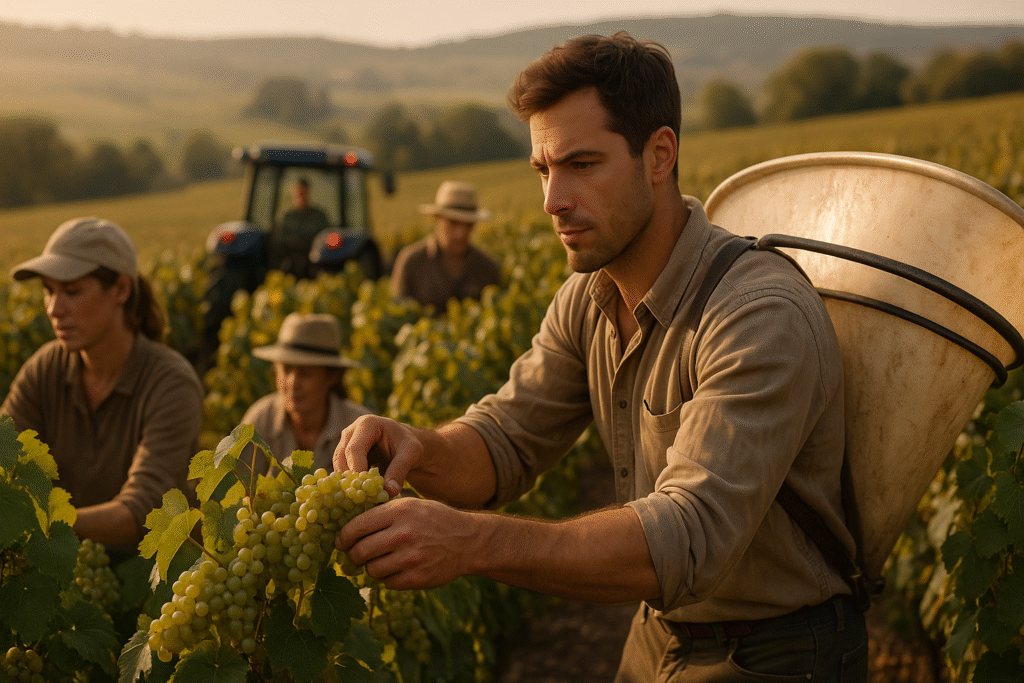
Hand harvesting enables preservation of cluster integrity, limits oxidation, and separates lots for precise vinification.
7. Challenges for the sector
The campaign mobilizes growers, houses, cooperatives, and seasonal workers. Accommodation, safety, transport, press scheduling: every link counts. Collective coordination ensures harvest fluidity and safety.
Labor and conditions
Early recruitment and team planning are decisive to follow accelerated maturity, respecting labor and accommodation regulations.
Role of professional organizations
The Comité Champagne, SGV, and UMC support decisions, disseminate information, and promote the implementation of good practices.
8. Economic data & markets
Volume management is conducted with regard to stocks, global outputs, and mix by channels. The valorization of cuvées relies on consistent quality and supply control.
Price and distribution trends
The sought stability protects brand image while enabling operators to invest in sustainable viticulture and tool modernization.
9. Long-term climatic challenges
In a few decades, the harvest calendar has moved significantly earlier. The sector is exploring adaptation levers: clonal selection, soil work, cover crops, shade management, and experimental irrigation where permitted.
Preserving the Champagne signature
The challenge is to maintain freshness, finesse, and aging potential despite hotter, drier summers, without distorting the wines’ identity.
10. Historical comparisons
The temporal shift of bans illustrates a strong trend. Dates formerly in early September now fall at the end of August, as in 2025 with a ban on August 20.
Lessons from early vintages
Early years require tight organization but can deliver wines of great purity if acidity is preserved and pressing is conducted precisely.
11. Field testimonies
Vineyard managers and cellar masters emphasize the importance of « sticking to the fruit »: adjusting harvest dates per parcel in real-time and press logistics to capture the right maturity.
Organization and responsiveness
« An early harvest is won through planning, » sums up a press manager: staggered convocations, optimized transport, continuous pressing, and lot traceability.
12. The « ban »: tradition & indicator
Born to frame the harvest, the ban remains a strong cultural and technical marker. Its history also serves as an indirect climate indicator, with dates reflecting the evolution of maturities over decades.
Modern function
Today, the ban harmonizes, secures, and signals the optimal window at the appellation level, while allowing each operator to fine-tune according to their parcels.
13. Risks & mitigations
The faster maturity progresses, the narrower the useful window. Main risks: imbalances, water stress, disease outbreaks if the weather shifts. Mitigation relies on anticipation and operational flexibility.
Key good practices
- Daily monitoring of maturities and berry tasting
- Organization of teams and transport under tight schedules
- Sorting by parcel and cluster integrity
- Precise pressing management and juice separation
- Real-time communication between vineyards, harvesters, and presses
FAQ — Harvest in Champagne 2025
Why is the harvest opening date set for August 20 in 2025?
Because of the advancement in maturity linked to the year’s climatic conditions. This date aims for an optimal balance between freshness and concentration.
Is the harvest entirely manual in Champagne?
Yes. Manual harvesting protects cluster integrity and the quality of juices intended for Champagne base wines.
How to reconcile technological and aromatic maturity?
Through parcel observation, berry tasting, and triggering harvest as close as possible to the aromatic peak while maintaining acidic freshness.
What is the impact of yields on quality and prices?
Yield regulation stabilizes supply, supports quality, and contributes to medium-term price/stock balance.
What are the logistical priorities during an early harvest?
Early recruitment, smooth transport, press scheduling, lot traceability, and continuous communication between teams.
Where to follow official recommendations during the campaign?
On Comité Champagne publications and via local professional communications.
Conclusion & perspectives
The harvest in Champagne 2025 confirms a marked earliness: the ban on August 20 concentrates efforts on a few critical days. Success rests on three pillars: fine monitoring of maturities, flawless organization, and precise pressing. By capitalizing on these levers, Champagne can turn this time constraint into a qualitative opportunity and produce wines that are both taut, pure, and destined for fine aging.